
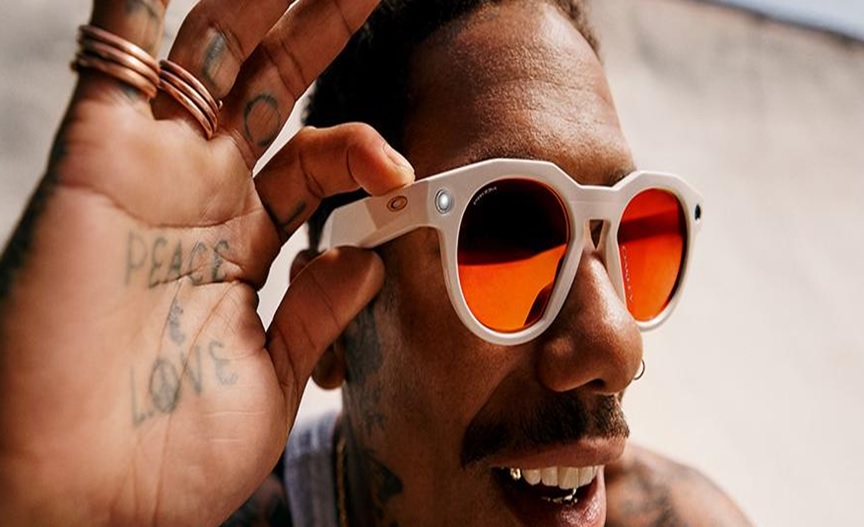

As wearable technology becomes more intelligent and more personal, it also becomes more complicated. Smart glasses — once a futuristic novelty — are now at the centre of conversations about how technology interacts with privacy, identity, and everyday life. With products like Oakley’s new HSTN Meta frames and Ray-Ban’s latest Meta range leading the charge, we’re witnessing an era where eyewear isn’t just about vision correction or fashion; it’s about connection, information, and data.
But with every innovation comes a responsibility — to protect not only what we see, but what the technology sees on our behalf.
From function to intelligence
In their earliest forms, smart glasses were experimental gadgets — bulky, tech-heavy and socially awkward. They were designed to prove a concept rather than serve a daily purpose. Today, things have changed dramatically. Smart glasses now look like stylish eyewear, offering lightweight designs, integrated cameras, microphones, and even AI-powered assistants.
The latest generation, including Oakley’s new HSTN Meta frames, shows just how far the technology has come. These glasses blend performance-focused design with built-in smart functionality, allowing users to access voice commands, audio streaming, and real-time feedback — all while maintaining Oakley’s iconic sport-lifestyle aesthetic.
This shift from novelty to practicality is what brings data ethics into sharper focus. When our glasses can record, analyse, and share information, the line between personal and public space starts to blur.
The invisible data trail
Every time a smart device captures or processes information, it generates data — and that data tells a story. With smart glasses, this story can become deeply personal. Cameras can record the world from a first-person perspective, microphones can pick up conversations, and sensors can detect movement, location, and even physiological responses.
For users, this level of capability can be empowering. It allows hands-free creativity, accessibility for those with mobility challenges, and a sense of frictionless digital connection. But for others — especially those being recorded unknowingly — it raises legitimate concerns.
Who owns the data your glasses capture? How long is it stored? Can it be accessed by the manufacturer, or shared with third parties? These questions are central to the ethics of smart eyewear, and the answers are still evolving alongside the technology itself.
Transparency and consent
One of the biggest ethical challenges in wearable technology is visibility — or rather, the lack of it. When you use a smartphone to take a photo, people around you can see what’s happening. But when you’re wearing glasses that can record silently, the dynamic changes.
Brands are becoming more conscious of this. Some, including Oakley, have been careful to emphasise design cues that signal when recording is active. Others are experimenting with subtle indicators such as LED lights or audible tones. Yet, the question of consent remains complicated.
The solution may lie in creating universal norms — much like the social etiquette that developed around mobile phones. Just as it became rude to take a call in the middle of a meeting, society may need to define new expectations for how and when smart glasses are used in public.
Data protection and responsibility
Beyond social concerns lies the issue of data protection. Manufacturers handling visual or audio data must now operate with the same level of accountability as any other tech company. That means clear privacy policies, opt-in permissions, local storage options, and regular security updates.
For example, Oakley’s new HSTN Meta frames reportedly focus on on-device processing, meaning more information stays local rather than being sent to external servers. This model — known as “edge computing” — is becoming an important part of ethical design in AI-powered wearables. It reduces the risk of data leaks, protects personal information, and builds trust between users and the technology they wear.
Governments, too, are taking note. Data protection laws such as the UK’s GDPR and similar global frameworks are likely to shape how smart glasses evolve, ensuring that innovation never comes at the expense of privacy.
Balancing innovation with accountability
It’s easy to see why tech companies are excited about smart eyewear. The potential use cases are huge — from real-time translation and navigation to sports analytics, remote work, and immersive media experiences. For industries like healthcare and education, the possibilities are even broader.
But innovation must move hand in hand with accountability. That means companies designing products like the HSTN Meta frames have a duty to make privacy not an afterthought, but a core feature. Ethical design should start at the hardware level and extend through the entire user experience — giving people control over their data and clarity over what’s being collected.
As artificial intelligence becomes more deeply integrated into these devices, the importance of ethical guardrails grows even further. AI systems learn from the data they collect — and if that data is biased, incomplete, or misused, the consequences can extend beyond privacy and into fairness, transparency, and societal trust.
The path forward
The future of smart glasses depends on more than what technology can do; it depends on what people will accept. As users, we crave innovation that makes life easier and more interesting — but we also expect respect for personal boundaries.
The good news is that the industry seems to recognise this. Companies like Oakley are designing products that combine performance and discretion, while prioritising user agency. The emphasis is shifting from data extraction to data empowerment — helping users benefit from the information their devices collect, rather than feeling monitored by it.
In the coming years, the most successful smart glasses won’t necessarily be the ones with the flashiest features. They’ll be the ones that build trust — transparently, responsibly, and with a clear ethical framework.
A more human vision of technology
Smart glasses symbolise the next frontier in human-computer interaction. They bring the digital world closer to our senses than ever before. Yet, as that boundary narrows, our moral responsibility widens.
Privacy isn’t an obstacle to innovation — it’s the foundation that allows it to last. When companies respect that balance, technology becomes not just more advanced, but more human.
As Oakley’s new HSTN Meta frames and other next-generation eyewear reshape what’s possible, the challenge — and the opportunity — is clear: to create smart glasses that see the world responsibly, not invasively. Because in the end, the future of data ethics won’t be decided by machines, but by the humans who design and wear them.
Comments are closed.